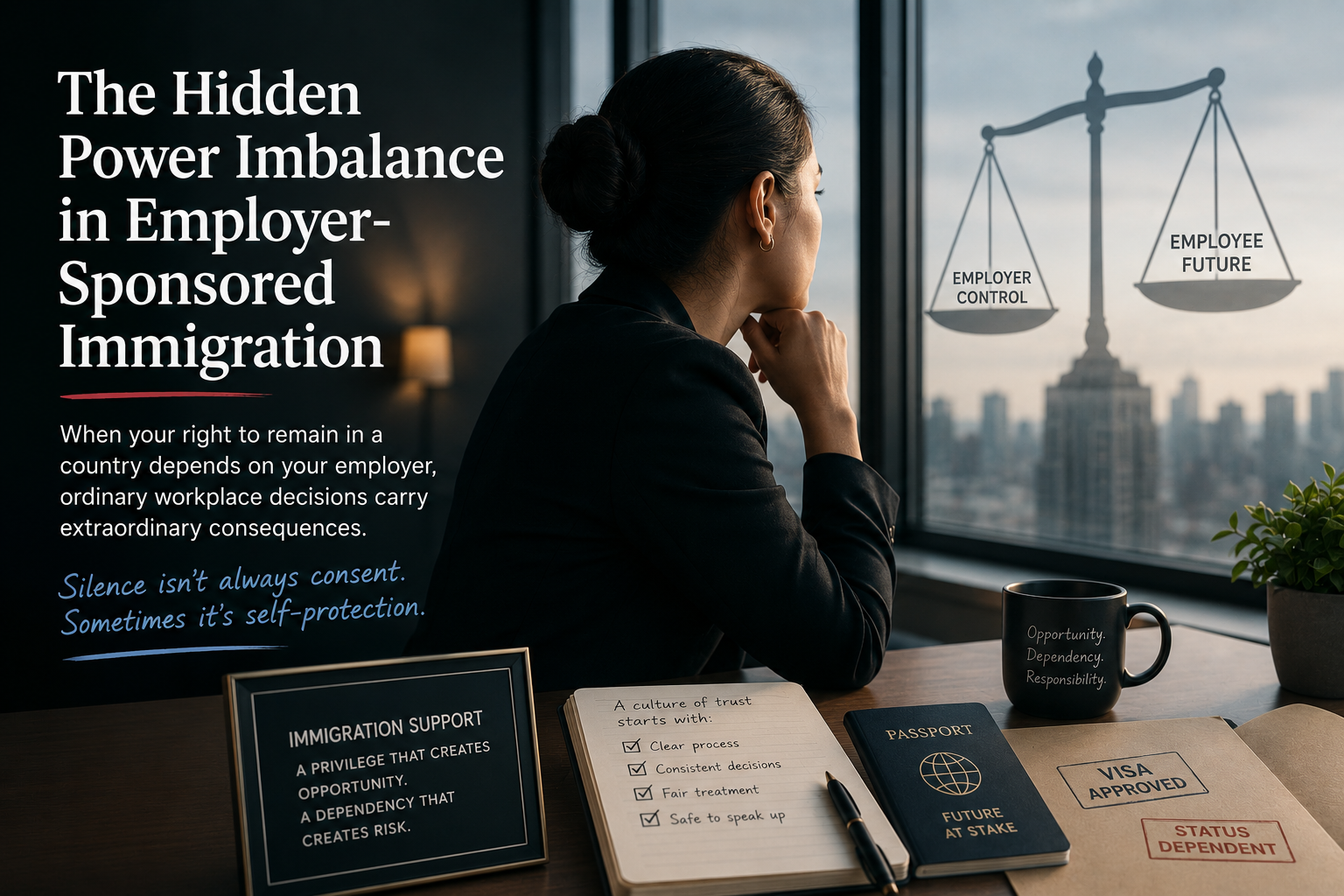
The employee had an excellent reputation.
They rarely pushed back in meetings. They accepted extra work without complaint. They had stayed through a difficult reorganization, two changes in leadership, and a period when several colleagues resigned.
Management described them as deeply loyal.
Then, during a private conversation, the employee said something that changed how the company understood the last two years.
“I did not think I could afford to be difficult.”
The manager assumed they meant professionally. The employee meant something much larger.
Their right to remain in the country was connected to the job. Their spouse’s plans depended on it. Their children were settled in school. Leaving the company was not simply a career decision. It could become a decision about whether the family could continue living where they had built a life.
Nobody had threatened them.
Nobody had said, “Agree with us or lose your status.”
The pressure did not need to be spoken aloud. It was built into the structure of the relationship.
The Employee Looks Loyal, but the Company Cannot See the Cost of Leaving
Employers like loyalty because it feels reassuring.
The person stays. They do not create unnecessary conflict. They understand the company, know the people, and remain available when the work becomes difficult. In a period of high turnover, the employee who never seems to look elsewhere can appear especially committed.
The company may be reading the signal incorrectly.
A sponsored employee may stay because leaving carries consequences that other employees do not have to consider. A new role may require another employer willing and able to support the relevant immigration process. Timing may matter. Family members may have their own dependency on the employee’s position. A move that looks straightforward on an organizational chart may be much harder in real life.
None of this means sponsored employees lack genuine commitment. Many are highly engaged and choose to stay for the same reasons as anyone else.
The problem is that the employer cannot know what retention means unless it understands the pressure surrounding the choice.
A manager may say, “They would never leave us.”
The employee may have spent months quietly researching whether another employer could take them.
That is not disloyalty. It is risk management.
Ordinary Workplace Disagreements Carry Different Stakes
Most workplace disagreements are uncomfortable.
An employee disagrees with a manager about priorities. They question a performance assessment. They negotiate pay. They decline work that falls outside the role. They ask for a transfer or challenge a decision they believe is unfair.
For a sponsored employee, the same disagreement may carry an additional layer of fear.
Will the manager see them as difficult? Could the role be changed? Could the company decide sponsorship is no longer worthwhile? Would termination affect the employee’s ability to remain? How quickly would the family need to make decisions?
The answers vary by jurisdiction, status, and individual facts. That is precisely why employees may be reluctant to take chances based on informal reassurance.
The company may see a manageable conflict.
The employee may see the first step toward losing the life they have built.
This can make ordinary compliance look unusually smooth.
The employee agrees to expanded duties. They accept inconvenient travel. They tolerate unclear reporting lines. They avoid correcting a senior person in public. They say yes before they have had time to think.
Managers may interpret this as flexibility.
Sometimes it is fear with good manners.
Power Does Not Need to Be Used Deliberately to Shape Behavior
Companies often think about power in terms of conduct.
Did a manager threaten the employee? Did someone mention immigration status during a performance discussion? Was sponsorship used as leverage? Did the company retaliate after a complaint?
Those are important questions.
They are not the only questions.
Power can shape behavior even when nobody actively uses it. The employee may believe the manager has influence over sponsorship decisions. They may assume that a negative performance review will affect the company’s willingness to continue support. They may not know where formal authority sits.
From the company’s perspective, the process may belong to HR, Legal, outside immigration counsel, or a senior executive.
From the employee’s perspective, the process may belong to the person who controls their daily work.
That distinction matters because employees do not experience governance charts. They experience people.
A policy may say sponsorship decisions are centralized. The employee may still believe that one unhappy manager can change the outcome.
That belief affects how they behave long before anyone checks whether it is accurate.
Silence During an Investigation May Be Self-Protection
Investigations rely heavily on people being willing to speak.
A company can establish reporting channels, promise confidentiality, prohibit retaliation, and appoint experienced investigators. Those steps matter.
Still, a sponsored employee may hesitate.
They may worry that the subject of the complaint will learn their identity. They may fear being labeled disruptive. They may not trust that formal protection will preserve the job if the relationship with management deteriorates.
Even where the law provides protection, the employee may not believe the company can guarantee the practical outcome they need most.
Will they remain employed? Will sponsorship continue? Will the matter become visible to the person who controls their work? What happens if the investigation changes the team structure?
These questions can explain behavior that investigators sometimes misread.
The employee gives a partial account. They minimize what happened. They say they do not remember. They ask whether the conversation is confidential several times. They return later with details they were not prepared to share at first.
An investigator may see inconsistency.
The employee may be testing whether the company is safe enough to hear the truth.
Delay does not automatically prove credibility, of course. Nor does immigration dependency explain every hesitation.
But it is part of the context, and ignoring it can produce a poor investigation.
The question should not only be, “Why did the employee wait?”
The company should also ask, “What did the employee believe would happen if they spoke sooner?”
The Manager May Hold More Power Than the Org Chart Shows
Sponsored employees often depend on the company for information, documentation, signatures, and coordination.
A manager may be asked to confirm duties, performance, reporting lines, or business need. The manager may not make the final immigration decision, but the employee may believe their support is essential.
This creates room for damaging comments, even when the speaker does not intend harm.
“We need to see better performance before we keep investing in this.”
“Remember how much the company is doing for you.”
“We can revisit sponsorship after the busy period.”
“Now may not be the right time to raise this.”
A manager may think they are discussing budget, timing, or performance.
The employee may hear a warning about their future in the country.
That is why managers should not improvise immigration language. They should not predict outcomes, promise support they cannot approve, or connect sponsorship casually to disagreement.
The words carry more weight than the speaker may realize.
A company may spend heavily to support an employee and genuinely believe it is offering a valuable benefit. That generosity does not cancel the dependency.
Both things can be true.
The employer can be supportive, and the employee can still feel exposed.
Performance Management Becomes Harder When Everyone Is Avoiding the Real Issue
Poor performance does not disappear because an employee is sponsored.
Companies still need to set expectations, give feedback, document concerns, change roles, and, where necessary, end employment. Sponsorship cannot turn an ordinary management problem into permanent immunity.
But immigration dependency changes the way the process should be handled.
Some managers avoid honest conversations because they feel guilty. They know the employee’s status may be affected and postpone feedback they would give another employee immediately.
The employee receives vague reassurance instead of a clear warning.
Months later, the situation becomes difficult to sustain. The company moves quickly, and the employee experiences the outcome as a shock.
Compassion without process can be as damaging as process without compassion.
Other managers move in the opposite direction. They treat immigration consequences as entirely outside the employment decision and communicate a termination without understanding what it triggers.
The company may be legally entitled to make the decision. That does not mean the process was well managed.
In-house counsel and People teams need to become involved early, before the performance issue and immigration issue collide.
The employment decision should remain grounded in the role, conduct, performance, and business facts. At the same time, the company should understand the timing, communication, and practical consequences surrounding the decision.
That is not favoritism.
It is competent process design.
A Sponsored Employee May Stay Too Long and Speak Too Late
The imbalance affects leaving as much as staying.
Employees who feel free to move can respond to a bad manager by applying elsewhere. They can negotiate more firmly, decline unreasonable demands, or leave when trust breaks down.
A sponsored employee may remain because every alternative appears uncertain.
That can keep the employment relationship alive long after it has stopped being healthy.
The employee stays through repeated disappointments. They become quieter. They stop proposing ideas. Their work remains competent, but their confidence disappears.
The manager sees stability.
The employee is waiting for a safer exit.
This is one reason resignation can appear sudden.
The company may believe the employee was satisfied because they did not complain. In reality, the employee may have been preparing quietly for the first point at which leaving became possible.
When the resignation arrives, leadership asks why nobody saw it coming.
The employee may have been signaling for months. The company interpreted silence as consent.
The Family Lives Inside the Dependency Too
Employer-sponsored immigration is often discussed as a relationship between the company and the employee.
The effects rarely stop there.
A spouse may depend on the employee’s status for work, residence, or future planning. Children may be settled in school. The family may have signed a lease, bought a home, or built community around the assumption that the employment will continue.
This gives ordinary workplace decisions a much wider reach.
A difficult performance review can become a family emergency. A reorganization can create questions about residence. A manager’s vague comment can send the household into weeks of anxiety.
The company may never see this.
The employee comes to work, attends meetings, and continues delivering. The family is privately discussing what happens if they have to leave.
This is part of the hidden imbalance.
The employer controls a job.
The employee experiences a structure connected to housing, schooling, family stability, and belonging.
Whistleblowing Systems Are Only as Strong as the Employee’s Sense of Safety
Companies often evaluate reporting systems by counting complaints.
A low number may be described as evidence of a healthy culture.
That conclusion is risky.
A quiet reporting channel can mean fewer problems. It can also mean employees do not believe the channel is safe.
Sponsored workers may be especially cautious where the complaint involves a manager, founder, or executive who appears to hold influence over their future.
They may also worry that the company will protect the person who brings in revenue, controls the team, or has direct access to leadership.
Formal non-retaliation language may not fully answer that concern.
Employees watch what happens to other people.
Who was promoted after speaking up? Who disappeared from the team? Who became known as difficult? Which complaints remained confidential, and which became office conversation?
This is where culture becomes evidence.
A company cannot tell sponsored employees to trust the process and assume the instruction itself creates trust.
The company has to earn it through consistent handling, controlled access, clear ownership, and visible protection against retaliation.
The Company Should Separate Immigration Authority From Daily Management
One of the simplest operational improvements is also one of the most important.
Employees should know who owns immigration decisions.
That authority should not appear to sit entirely with the direct manager, especially where the same manager controls performance ratings, work allocation, promotion, and day-to-day access.
A clearer structure reduces the risk of informal pressure.
The employee should understand which decisions are discretionary, what conditions apply, who approves support, and where questions can be raised outside the reporting line.
Managers should understand their own limits.
They should not promise permanent support during recruitment. They should not threaten withdrawal during conflict. They should not describe immigration outcomes as certain. They should not imply that raising a concern will affect sponsorship.
Specialist counsel can advise on the legal position. The embedded legal team or Compliance Officer can make sure the advice reaches the right people and becomes part of how the company operates.
That is legal as infrastructure.
The work is not finished when counsel gives the correct answer. The company needs a process that prevents the wrong person from giving a different answer later.
The Company Still Has to Make Difficult Decisions
There is a risk of overcorrecting.
Once leadership recognizes the imbalance, managers may become reluctant to manage sponsored employees at all. They may avoid discipline, postpone restructuring, or make exceptions that create resentment elsewhere.
That is not sustainable.
Sponsored employees remain employees. They should receive clear expectations, fair feedback, consistent treatment, and decisions based on legitimate business reasons.
The difference is that the company should not pretend the consequences are identical.
An employment decision may be lawful and still require more careful planning. A termination may be justified and still need better communication. A role change may make business sense and still need immigration review before it is announced.
This is where operational legal leadership earns its place.
The Chief Legal Office does not remove management responsibility. It helps the company act with clearer eyes.
A Trustworthy Sponsorship Model Reduces Guessing
The company cannot eliminate every dependency created by employer-sponsored immigration.
It can reduce unnecessary fear.
Employees should not have to guess whether a manager controls their future. They should not learn about sponsorship conditions through rumor. They should not receive different answers from Recruiting, People, Legal, and leadership.
The company should know what it offers, who approves it, what is recorded, and how changes are communicated.
Reporting channels should recognize that immigration dependency may affect willingness to speak. Investigators should consider it when assessing delay and witness behavior. Performance processes should involve the right teams early.
None of this requires the company to promise outcomes it cannot guarantee.
It requires the company to stop treating the immigration relationship as a separate administrative file.
It is part of the employment system.
Silence Is Not the Same as Trust
Return to the employee from the opening.
Management believed they were loyal because they stayed. They believed the employee was satisfied because they did not complain. They believed the relationship was strong because there had been so little conflict.
Those conclusions may all have been wrong.
The employee may have been calculating consequences the company never had to calculate.
Employer sponsorship can create opportunity. It can bring talent into a company, support families, and allow people to build lives they could not build otherwise.
It can also make an employee afraid that one workplace conflict could destabilize everything.
That is the part companies need to see.
A healthy company does not measure trust by how quiet a dependent employee remains. It builds a process in which honesty does not feel like risking an entire life.